|
|

|
DNA
Testing in Felines
By R. Wixson Earlier this year, I had
the situation arise where a female of mine was pregnant and I knew that she had
been exposed to 2 different males. While one was young and I had never
seen him breed, the fact was still there that he was running loose in the home
with this girl. I began a search to find out about DNA testing and what
was involved in the process. Since then, I have had many requests for the
information that I obtained and questions about the process. Below is my
experience and this article is intended to help with others that may need the
information. I decided to use the University of California at Davis.
I first called them on the phone and ordered my “swab” kits. In my
case, I had 1 mother, 2 “possible” fathers, and 5 kittens. Within a
few days, a box arrived with numerous brushes and some paperwork. They will send
you 2 swabs for each cat/kitten to be tested. There was no charge for
these swabs. Each swab comes in a sterile paper/plastic wrapper that has a
label on it. You will need to write each kittens name (or assign them a
number if you do not have names) on each wrapper remembering that there is 2
wrappers for each cat/kitten. I used 16 swabs (2 for mother, 4 for the
fathers, and 10 for the kittens). When you open the wrapper, make sure you
only open a small part at the top because you will be reinserting the swab into
the original wrapper and mailing it back. When all your wrappers are labeled, it is time to swab
the cats. Take each cat/kitten and hold them in your lap. Place the
brush into the mouth and gentle brush the outer gums and/or cheek. You do
not need to press hard and you will not “see” anything on the brush when you
are finished. Do this for approximately 10 seconds for each cat/kitten.
When you are finished, place the brush back into the original wrapper and repeat
with the next brush on the same cat/kitten. When you are finished, move on
to the next one. One important note is to make sure the cat/kitten has not
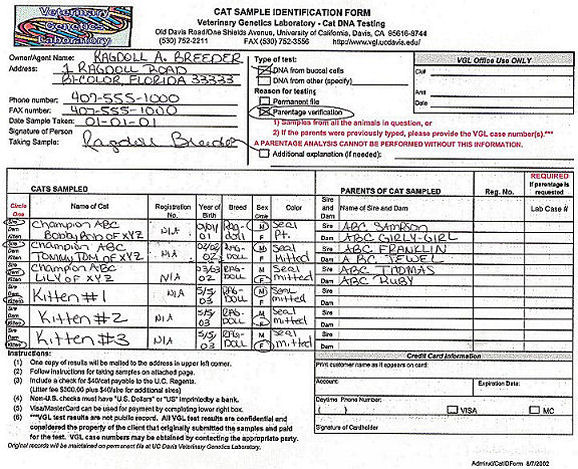
eaten anything recently. Once all cats/kittens have been swabbed, place all your swabs in their wrappers into a box and seal the box. Take your form and fill it out to match your swabs. Place the form into the box with the swabs, along with your check for services, and mail back to UC Davis. I have attached a sample form to be used as a guide. In approximately 3 weeks, you will receive a document back for each cat tested. Each kitten will have his or her own paper and at the bottom it will state who the “match” was. Once a cat/kitten is tested, a number is then assigned to that cat and should you ever need to use it again, you will not need to reswab the cat. Just simply place the number on the line next to the cats name and they will be able to research it from their database and use it.
This is a very strict and confidential service. If you provide a fax number on your application, they will FAX you a copy of the results and then mail you a copy also. If you do not provide a number at the time of submitting an application, they WILL NOT allow you do so later and NO information will be given out on the telephone. |
|
For further information e-mail
RFW Club Graphic design and website creation by Mindy
Ferreira.
|